Sunday, April 18, 2010

Open magma systems and a Mothra on top

So for the past few days I have been diligently working on my Geochemistry paper and on my Entomology independent project.  It has been very slow going on both beyond initial framework setup for the writing.  I usually don't have as much trouble as I have when writing, and the problems I have had are entirely new to me.

For my geochemistry paper, I have had to worry for the first time in a long time about: plagiarism.  See, with the crystal samples given to us by Dr. R I have no idea what the locality they were taken from was like at all.  I've certainly been to Valles Caldera enough times, but never have I taken any samples of my own from the caldera's formations, and with his published papers he has given us to use as reference, it's had to say anything without having to paraphrase and cannibalize heavily from his writing.  My interpretations are entirely my own but everything from the background and methodology to the major sources I am citing are all heavily borrowed from Dr. R's papers.

The ten grains we successfully analyzed match Dr. R's conclusions that the 1.61 Ma Otowi Member we are studying originated from an open magma system.  The difficulty for me now is how to balance respect for my teacher's publications with further reading I've done and my general ignorance of the member beyond its geographical location.  Dr. R suggested in the papers he gave us that "sweated" wall rock was principally responsible for the open system dynamics we seem to see, but I've come across a few other papers suggesting that an injection of magma spurred the eruption and contributed to the variance we see in rubidium-strontium isotope ratios to suggest an open system to us.  Now I have to pull all of it together into a draft Dr R is willing to buy into, and still not see enough of his own papers to blow a whistle on the derivative writing I currently have.

Meanwhile, my entomology project is significantly less demanding and although I realized I ought to start writing 9 days before the due date (April 23), I have more than half of it already done.  I've drawn and written three quick comics (he asked for strips but I don't know what to make of that), a movie review of Mothra vs. Godzilla (1964) and four website reviews (just a paragraph each).  The website reviews were surprisingly fun, and I got to talk about the Prehistoric Planet Store and the USDA Insect Sound Reference Library.  Mainly though, any excuse to watch a Godzilla movie and get points on an assignment for it is ideal.

The next project I'll have to undertake is my Colorado Plateau poster.  I still haven't settled on what I would like to write on.  Part of me wants to deal with the boundary of the Interior Seaway and the Sevier Orogenic Belt.  The other part of me wants to go nuts with the inter-fingering of the Mancos Shale and the Drip Tank Member, which are really impressive just due to the dynamics of the shoreline of the Great Interior Seaway.  I'm not sure what I'll do, but I ought to choose quickly.  I just don't want to fall into the trap of using my professor's publications for this assignment as well, though Dr. L has some really interesting papers dealing specifically with the Cretaceous...


Overall, not a lot is going on in my life besides writing and getting ready for finals when the time comes.  These papers and projects are a huge part of my grade though (equivalent to a full exam in Entomology) so I really want to get them done and done right.  Meanwhile the weather just gets better and better here and I'm stuck inside typing away when every instinct worth listening to in me wants to head outside and take a literal breather.  Life goes on, and I'll definitely have the summer so things could be better but I'm doing really well as my second year nears to its conclusion and I'm really proud of that.

Photo Credit
Ron Blakey, Northern Arizona University Geology. "Paleogeographic map of the Late Cretaceous (75 Ma)". Link

Friday, April 9, 2010

The laser tags me back for my neglect

So it's been a long stretch of time again since I've posted anything, and with the uneventful spring break I had there really isn't much excuse why I didn't jot something down with everything that has been happening.

School has been pretty time consuming lately, and with a sudden urgency to write papers coming due before the end of the school year I will be doing a lot more writing on my Geochemistry project, Colorado Plateau poster, and some Entomology papers for my elective class than any recreation writing.  I have a lot of anxiety right now about all that writing simply because I haven't started on any of it, but I hope to remedy that by the weekend.

I've been really happy to be learning about the (TIMS) mass spectrometer and the chemistry that goes with it.  I'm reluctant to be such an easy catch for Dr. R, but geochemistry has really caught my attention this semester and if I work for him this summer I will probably get even more into his type of work.  Next semester should be a good time to test how much I really enjoy it though, when I'm taking more sedimentary based classes.


My schedule for next semester is essentially complete after today.  I have GEOL 399 Igneous and Metamorphic Petrology, GEOL 420 Stratigraphy and Sedimentology, GEOL 465 Isotope "Geoghemistry", GEOL Structural Geology, and GEOG 381 Cartography and GIS.  This will be the heaviest 15 credits I have ever seen assembled together, but I certainly won't be working next semester so I feel that I persevere.  It feels odd to have all of my general education credits nearly covered as this semester comes to a close.  My only non-departmental elective I haven't covered is an engineering or programming course, but the GIS course could be covered under the new catalog if my sources are right...

Thursday was an unusual day considering the past month.  I had been severely neglecting my LIBS work by doing Geochemistry work and today I finally got back to my LIBS data.  I hadn't realized that I had 12 data sets just waiting to be analyzed so it was long overdue to sit down with Dr. M and run the Unscrambler software to analyze my spectra.  Running those 2100 shots with 13701 spectra each took a long time though, and so I was at school from 8:50 to 6 with only one two hour class to go to, and I was sad to miss out on the laser tag event the school was hosting that night.  I guess when you trade up in laser class it's hard to go back to the simpler tools of learning you had as a child.


I have had some very good times lately though, and I have to say this is a very happy time in my life right now.  Coming off of spring break after visiting with a lot my good friends back at home and taking it relatively easy in the shadow of midterms, I can't complain.   I may have two midterms next week already and due dates on papers quickly approaching but this may be the golden semester compared to what in my future classes.  All I know is that tomorrow will be a relief from today's nonsense, and over the weekend I am going to make some serious dents in those papers!

Photo Credit
Cornell Geology Department Facilities. "Thermal Ionization Mass Spectrometer"

The Sydney Traveler. "Code Red" (for Code Red Leisure Centre)

Thursday, March 18, 2010

Midterms and Molarities

So this week has been a little more busy than typical, due to a combination of several midterms this week and coming down with a quick cold (or some similar illness).  However, with midterms comes the great relief one feels at the end of an important exam.  Every day this week has felt like a Friday, partly because of the improved weather and partly because each test finished and school day completed brings me closer to Spring Break.

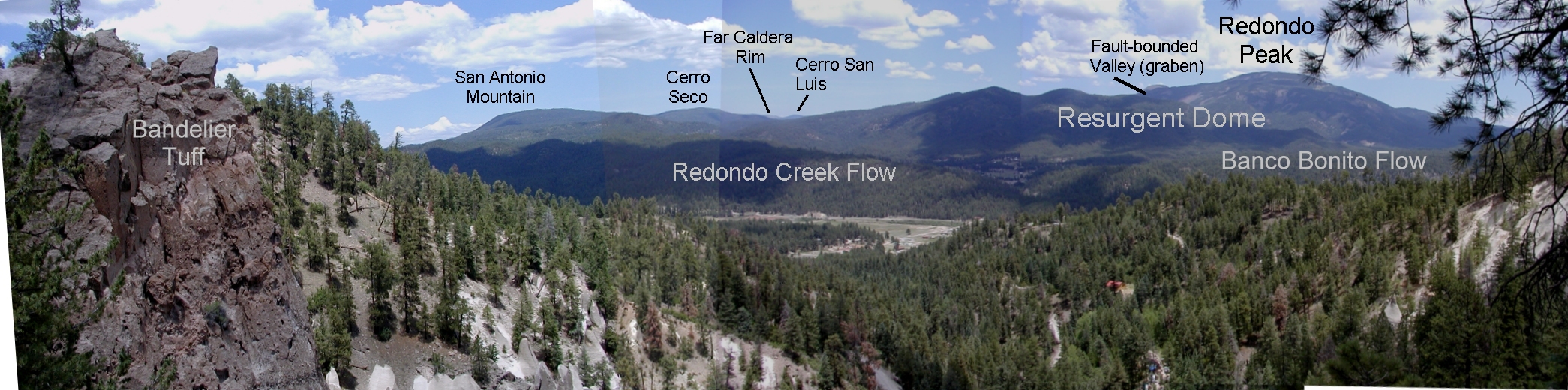
This week has also been exciting because a group of my peers and I in Geochemistry have been diligently working on preparing the crystals our teacher wants us to analyze.  Our teacher is an isotope specialist, who focuses a lot on the element Strontium, and works mainly with igneous rocks.  Subsequently we are going to run the entire digestion, column chemistry, and mass spectrometry work on crystals from Valles Caldera in the Jemez Mountains.


This caldera was the result of a small super-eruptive volcano, and there are calderas below the Valles (the Toledo Caldera being the main example).  I've been all around the area many times both camping and hiking, but have somehow never read anything about the geology of the area beyond the eruptions that caused the caldera systems.  It'll be interesting to learn about this place in a new light.

This geochemistry work however has shown me two very important things about myself.  I, unlike my geochemistry instructor Dr. R, am a very shaky person when it comes to handling fine instruments like micropipettes.  I have also found that I have a more than healthy respect for hydrofluoric acid and have been extremely relieved to have made it through our digestions without burning myself with any of it.  I did have the thumb of my glove disappear and I definitely burnt myself with something in the clean lab, but it was really very minor considering the concentrations of the acids we use to break down these crystals.

The irony of all this exciting work is that Dr. R had been putting it off for some time hoping to photograph the crystals with a special computer he ordered and had been waiting for.  Since we started this week, his computer naturally came today after we've dissolved them and have since started to prepare them for column chemistry to get the Sr out.

I feel truly privileged to have to opportunity to get the clean lab and analytical experience this Geochemistry project will offer.  It has really made me appreciate just how difficult preparing and analyzing rocks is on the chemical side of Geology.  I'd always known that it took thousands of man-hours to make geologic maps, measure sections of an area, and the like but I never knew putting samples through a mass spectrometer would be so involved.  I only hope that I don't mess up any of our samples, and that we can finish our runs before the write up for the class is due...

Photo Credit
Allan H. Treiman and Lunar and Planetary Institute. "Redondo Panorama 2 (Annotated)"

Monday, March 8, 2010

Paradox Basin lives up to its name for me

So, as promised I have the figure of the evaporite deposits in Paradox Basin, UT.  I've been really fascinated by these well logs, trying to figure out what sort of settings they must have formed in.  Since the key is difficult to read: green is halite, maroon red represents potash, and the gray is a gray shale.

Paradox Basin Well Logs

As you can see the pattern of deposition is always shale during stages of furthest transgression, followed by evaporite rock forming until the last of the potash dried.  Glaciation is believed to have subsided from time to time and the basin or salt flat would have recharged.  My main issue with this stratigraphy, given the near certainty that recharge must have occurred, is that the highly soluble potash top layer should have by all accounts been dissolved when the area was recharged. We also see slight layers of halite before any shale is put down which would have capped the potash and kept it in place.  If the recharge really did come from glacial melting, why does this recharge water not pick up the evaporites faster than it caps them with shale?

From the 28 cycles of halite we see in the sequence, our class determined that the rate of deposition for the evaporite and shale layers averaged around 0.1 mm/year (well within believable bounds considering modern deposition rates).  The glacial cycles also match historic trends well (not our current outlier, but previous cycles of ice ages) so the resurgence of glacial water was a dependable factor.

The deep valley/basin model some suspect formed the deposits would have provided (in my mind) enough water to dissolve the evaporites without having a deep enough water column to worry about temperature preventing uptake of evaporite sediment.  A salt pan model seems like a better candidate to me, but even that seems unlikely given the extant of the evaporite deposits, which can be pretty sizable.

I was already excited to see some of the salt tectonics of Paradox Basin in person when our class goes to visit the Colorado Plateau this summer. Now, after our teacher has introduced some features that could have placed that salt, I'm more interested to learn about current theories of what was happening in that part of the world that we now have these wonderful deposits of salt to consider.  It also makes me wonder what other curious oddities nature has hidden in remote locations of our planet, waiting to puzzle us and earn a namesake to remind us that not so long ago we thought we had most of the basics down...

Photo Credit
Hite and Liming. "Pennsylvanian Stratigraphy of Paradox Basin"

Monday, February 22, 2010

The month of waiting around...

Well it has been quite a while since I've written here, but I have excuses!  Mostly I was waiting for my professor to put up an image from a slide he had in class so I could talk about the salt and potash deposits in the Paradox Basin.  My Colorado Plateau class had a great discussion on the Pennsylvanian salt deposits in that famous basin system, and I really wanted to have the stratigraphic representation of well logs he put up before I began talking about anything relating to the basin.

I've also been waiting for insurance people to settle the totaling of my '99 Chevy Lumina, which was hit by a drunk driver on Superbowl Sunday (February 7th).  It was a long and anxiety inducing process, but I finally had it towed away sometime today while I was at school and we settled on the money it was worth last Friday.


Now I have been looking at vehicles, mostly jeeps and small four wheel drive capable cars, so that I can get for around the compensation money the totaling gave us.  This has left me spending a lot of time researching potential replacement vehicles and biking to and from classes at the university.  The half mile ride isn't too long or cold to need a vehicle, but the entire campus is placed on a hill and it seems all the more steep for my lack of motorized transport.

These things aside, my life has been pretty ideal.  I have done very well on my first round of exams, especially in Geochemistry, Entomology, and regular Chem. The weather here in Las Cruces just keeps improving, with temperatures almost reaching short-weather highs.  Almost.

The main academic concern I have right now is with my LIBS oil research.  I have seven oils analyzed with at least 140 samplings for each.  Enough, I feel, to begin using the analytical software my adviser has to examine what our LIBS data can be used to investigate.  At the moment the primary concern is still looking at reservoir rock traces in the oils to show how LIBS analysis could be used as a first notification of changing conditions in oil samples.   If the LIBS data will be useful for those ends will be interesting to see.  The technology has always been introduced to me as "quick and dirty" and I have had enough oil on my hands to believe it.

Thursday, February 11, 2010

Graduating to three dimensions

Looking back at my academic career an interesting thing occurs to me: my teachers were always holding out on us with the third dimension.

Before I began learning the beautiful things calculus can represent and model, the only time I recall using the third dimension in any work I did was for measuring simple volumes (of spheres, cones, cubes, etc).  My entire world seemed to be made of algebraic curves and trigonometric triangles.  When someone traveled on an airplane for example, I made a line or curve across a flat map to track their progress.  Molecules had simple lewis dot structures to show their orientation and that was that.

As I learn about the true mechanics of waves, moving bodies beyond simple particles, and molecular arrangements due to certain bonding schemes I realize the main difference between college level and high school level learning seems to be paying attention to a third dimension.  Towards the end of my high school career I had some advanced classes in physics and some calculus that introduced concepts that consider the third dimension, namely the right hand rule for cross products (not that we were told that was what was going on) and to find where those volume formulas of yore were derived from.

I remember the right hand rule enraged me when my teacher explained that was how all the electromagnetic forces we would be considering were handled.  Why should I have to contort my hand and then align it with the forces explained in a problem?  Surely there must be an easier way?! 

There was were vectors.  I think our teachers teased us with our early introductions to vectors.  Planting the seeds of a third dimension then and there, possibly testing our potential for higher learning with those first rudimentary lessons that never seemed to go anywhere but was still "in the curriculum".  I must have passed those quiet tests, those subtle moments that lay my entire intellectual merit bare for inspection. 

I have had a lot of instructors put their faith in me as a competent student based on a prior teacher's recommendations.  I can't say with any confidence if I deserved that trust and opportunity, but here I am in college coming to terms with everything they didn't teach me.  However, I am also coming to realize how they still laid the groundwork for later education, whether I was going to make it here or not.  Now I understand why graduation felt like a hollow ceremony compared to my entry into calculus: I had been weighed and measured long before that decorated day.

Saturday, February 6, 2010

The Jung and the Restless

This semester, I have a considerable number of blocks of time in between classes where I have to find something to do, but it isn't worth heading back to my apartment or start doing research work.  Lately I've been spending the majority of that free time walking the shelves of the main library on campus.


Zuhl library is an interesting place for a number of reasons.  First, it is purely a literary repository with Branson library containing the public documents, maps, and other great caches of scientific works.  Secondly it has a huge collection of petrified wood donated from its namesake: Herb Zuhl.  Thirdly, it has the most accommodating seating and lighting to read and lounge away free time.  With the weather warming up, most of the people squatting in the libraries for the warmth are also clearing out, so it has become a great place to haunt.

So, for the past three or four months I have had a terrible time committing to a book.  I've browsed and surveyed over a half dozen books, but haven't settled on anything since I finished Khalil Gibran's The Prophet.  I tried reading John Wesley Powell's account of his trip down the Colorado River, read a bit of a fictional story of a sleepwalking bookie with a family curse, and a few other odd books just picked at random from the shelves to fill my time.

After nearly a week of this fruitless searching, I think I've settled on reading through the Carl Jung's Psychology of the Unconscious.  I had actually begun to consider reading his works a long while back, but repeatedly found the compilation-style volumes usually offered in bookstores to be uncouth and frustrating. Now that I have a large library at my disposal I can find more well portioned works of his.  As much as his ideas are referenced in psychology, music, and countless other places I have yet to come across any non-psychology/philosophy major who has read any of his vast writings.

As much as the cliche of self-discovery in college is touted, separation from parental influence is the main reason I've seen people change.  People pick up new music tastes, new friends, start smoking or drinking things, but only minor worldview changes occur.  My own personality and opinions have been rather static for a long while now, at least from the start of high school.  As nice is it is to offer a reliable element to my friends' lives I've felt stunted and unsatisfied.  I'm hoping if I start looking towards my subconscious, I'll overcome most of the neurosis in my life.

As happy as I've been with my classes and social intimacy, I haven't been at peace with my life.  There's not much to complain about with my lot, but I do find myself wanting.  My school work keeps me pleasantly occupied and learning, and my friends and family are more distant than I'd like but I know they are there for me.  That just leaves myself to work on, and I hope that the promising ideas I've come across from Jung will help fill my free time and the personal vacuum I've felt in my life.