Saturday, July 23, 2011

Spring 2011 Semester: How my Junior year got me 3/4 of the way through undergrad

Junior year is commonly expressed as the most difficult portion of college.  The classes are no longer remedial, your teachers have often taught you before and know how to demand the most out of you, and it seems every instructor believes their course is the most important class you are taking at the time.

I cruised through most of my spring semester relatively easily.  My course load was initially light because our Field Class did not start in earnest until a month in.  With the inclusion of the field class I managed to adjust and keep a steady pace through the majority of the semester which appeared to pass more quickly than most.  It wasn't until the last three weeks of the semester that I began to feel the pressures of deadlines and faced the shocking realization that although I had worked steadily and reliably on all of my projects, there was no way I could finish strongly on all of them.  I wrote six papers or reports during the last two weeks of the semester, and was remarkably burnt out as I faced the coming three weeks of Field Camp a week after finals.  Looking back at the semester, I'm still perplexed how I became so busy during the last month of school but I only had one paper I feel was inferior work and I'm proud to have made it through this semester more than any other.

Tectonic Evolution of North America

This course is intended to be a capstone of sorts, integrating every course before it into a means of understanding how western North America came to be, from the accretion of terranes onto the craton all the way to the most modern expression of faulting in the Basin and Range province and Rio Grande Rift.

Monday, July 18, 2011

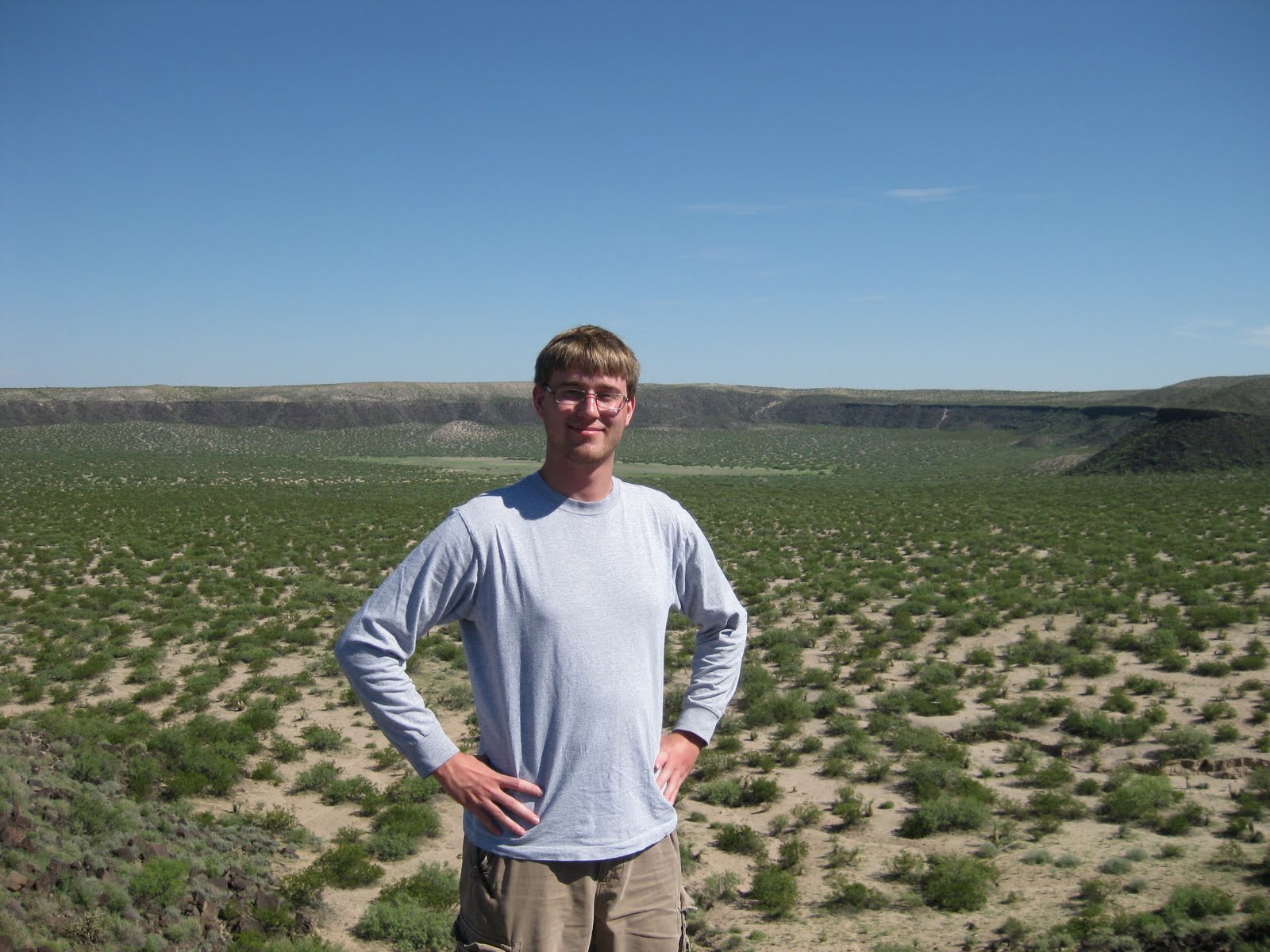
Visiting Kilbourne Hole (Geology, Rockhounding, and Geocaching)

I have to admit that I was ashamed of how long it took me to finally drive out and visit the famous Kilbourne Hole.  I had heard that the dirt roads were a bit tricky to navigate so I brought along my roommate as a hiking partner and to read the driving directions (the good ol' buddy system).


Fall 2010 Classes: Finally getting to the good stuff!

After two semesters taking "general education" courses: Intro to Geology, Fossils and Evolution of Life class, Mineralogy (with a semester of mineral identification and another for optical interpretation), and a Geochemistry class which was great but more on the theoretical side, I  I was plenty ready to begin taking more field and rock based courses.  The fall of 2010 semester did not disappoint and certainly validated my choice to major in geology.

Igneous and Metamorphic Petrology

Igneous and Metamorphic Petrology happened to be a reprise of Geochemistry for the first couple weeks, with a solid review of Bowen's reaction series, the layers of the Earth and of the three major plate tectonic margins.  I did however begin to better appreciate that tectonic motion is strongly tied to mantle convection and my first introduction to thermodynamics as they apply to earth systems was a refreshing change from the more elementary chemistry and physics explanations I had received in college.  Our textbook for the class Principles of Igneous and Metamorphic Petrology 2nd Edition by John D. Winter is really a great reference and was the first geology text I wanted to make sure I kept.

My main take away from the course however was how igneous and metamorphic textures of minerals within a rock aid in determining the petrogenetic history of that rock.  Phase and Ternary diagrams were also used to their full effect in this class, and these really helped me to understand the basics of the processes occurring within magma chambers during crystallization, melting, and recharge events.  Overall though, it was nice to actually deal with rocks in hand sample (even if we did get a bit sick of basalts) and to use thin sections and to find which skills we acquired in optical mineralogy were most useful was also a thrill.

Mafic enclave within rhyolitic or dacitic rock in Cleophus Canyon, near Ft. Selden, NM.  Access is limited since there are petroglyphs within the area as well.

Saturday, July 16, 2011

ASU Analytical Trip (August 11, 2010)

So, after returning from my east coast trip I worked for a while under Dr. R until it came time to take another trip to do analytical work on another university's equipment. This time we headed to Arizona State University to use their SIMS - Secondary Ion Mass Spectrometry - machine (a CAMECA IMS 6f).


Catching up after a year + of silence

It has been over a year since I've posted on this blog, which can tell you one thing: BUSY YEAR.  Seriously, it has been a good kind of busy and somehow never got around to recording any of that hectic goodness so I'm attempting to hit the geologically important points of the past year in a few posts.  Specifically I'll try to touch on:


It is a bit of a tall order after not updating for so long, but I'll try to be as thorough as a year worth of activity deserves.

    Sunday, June 27, 2010

    New York and Philadelphia

    Shortly after my analytical trip to California I returned home and immediately left for the East Coast.  For our trip we visited Philadelphia, Long Island, and New York City.  Although there wasn't a major portioning of geology for our trip I did see some interesting things it was great to see some of the landforms and features of the Eastern US.

    In Philadelphia, we visited all of the typical tourist spots of American History: the Liberty Bell, Independence Hall, the US Mint.  We also walked around a great deal, soaking in the city and resting in the parks of the city, most placed in large squares about a square block in area.  I saw a fair amount of schist and gneiss in the walls of Eastern State Penitentiary, the famous prison of Pennsylvania.  The walls sparkled with micas but were otherwise drab metamorphic rocks with regular foliation.


    On Long Island we visited the beach, where I was surprised to see the local park service people were working to protect sand dunes.  In New York City, I was glad to visit Central Park which was very near our hotel.  It was fascinating to see evidence of glacial activity preserved in the middle of a city.  I had never had a chance to actually feel the striations of glacial movement, so it was a real treat.


    We also visited the American Museum of Natural History, where I took enough pictures just of the paleontological to run through my camera's battery.  I was really pleased to see how well done their general geology section was, and their sampled deep sea chimneys from the Juan de Fuca Ridge were fascinating.

     
    We took so long walking through the museum that we had the gem and mineral section close on us just 15 minutes after we walked in, but that just means I will have to come back and give it the attention it deserves!

    Colorado Plateau Trip (South-East Rim of the Grand Canyon)

    We awoke in Bonito Campground to frost on our tents and a cold breeze blowing off the nearby mountains.  I had forgotten to check with someone who had a copy of the schedule of duties for our trip and had slept in, unknowingly neglecting my group's turn to prepare breakfast.  After everyone had their fill of oatmeal and bagels, we made up for our mistake by doing the dishes and cleaning up instead of the scheduled group.

    We headed out and stopped to take another picture of San Francisco Mountain and then began our drive to the South Rim of the Grand Canyon at Desert View.  It was a relatively short drive (83 miles) and although we saw a few minor canyons on our approach, it was relatively plain scenery with a slight climb in elevation as we approached the Grand Canyon.

    We parked in the huge lot for the Desert View visitor center and walked to the observation point.  Speaking personally, every time I see the canyon for the first time, it takes my breath away.  Its size is just staggering, and its colors are so varied that it seems more like a work of art than layered strata.


    I found myself frustrated by the hazy conditions of the canyon that day because, due to the winds of the moving cold front that just seemed to follow us, dust was picked up in the turbulent conditions.  Still, it was sunny and warm enough to truly enjoy the magnitude of erosion and time that lay before us.

    Our guide and teacher Dr. L discussed the roughly 1° dip of the Kaibab limestone (shown in the photo, possibly exaggerated due to my poor photographic skills).    He pointed out for us where strata pinched out and where new layers of rock appeared as you looked further down the canyon to the West, and reminded us that the river once flowed North-East (shown by reversed dendritic features of the Colorado outside of the Grand Canyon in the picture below).  We had a view of John Hance's old asbestos mine.  My peers presented posters on the the general canyon and on caves and waterfalls within the Grand Canyon, especially in the Muav and Redwall limestones.


    No comprehensive trip to the Colorado Pleatau could ever be said to be complete without visiting the Grand Canyon, and although I'd been there once before it was still as amazing to see it at another visitor center.  This visitor's center was really interesting because it had a watchtower which, although under construction, an amazing view 70 feet above the ground.